
Sport Fishing for Bonitos on the Ebro Delta in Spain: An Exotic Fishing Experience in the Mediterranean
I went fishing in mid-June with my dad on the Ebro Delta in Spanish Catalonia, to explore this unique and well-known environment, shaped by the freshwater from Spain’s largest river flowing into the Mediterranean Sea.
For this little fishing trip, the goal was clear and focused on one particular species: sport fishing for bonitos in Spain, called “bacoretas” in Spanish.
To do this, we decided to go with a guide, because bonito fishing isn’t something you can just learn in a day, especially when it comes to knowing the right spots to find them.
"To do this, we decided to go with a guide, since bonito fishing isn’t something you can learn in just one day, and even less so when it comes to knowing the right spots to find them".

The trip’s schedule got a bit messed up by bad weather, which here in Spain is almost always due to wind!
As a result, we had to postpone the outing twice because the winds were too strong for proper fishing, even though sailing would have been possible.
Finally ready for some sport fishing for bonitos in Spain on the Ebro Delta!
Two days later, we’re finally on the water, ready to fish! Early wake-up at 5:30 a.m. to meet the guide at the port of Riumar.
Waiting for the weather to improve turned out to be the right call. This morning, the delta looks like a lake, and the mouth of the river, which was covered in foam two days ago, is now perfectly calm.
After passing the sandbank, the guide speeds north for about 20 minutes to get close to a bluefin tuna farm, where all sorts of tuna gather, attracted by their fellow fish trapped in the pens.

The guide starts by positioning us in the spot and begins chumming with sardines.
“The technique is simple since we knew the fish were more or less in the area. The guide starts by chumming, using small sardines to bring the bonitos under our boat, and then we cast our hooked sardine right into the mix.”
The technique is based on the idea that the fish will go after the “free” sardines, get comfortable with this food source, and then, in their excitement, take our hooked sardine with the hook well hidden!
Very quickly, we noticed that the neighboring boats were hooked up—an obvious sign that bonitos were in the area.
Five minutes later, I got the first bite, pretty strong for the first fish of the day.

We spent the whole day fishing with Agusti’s gear, our guide, using really good equipment (Penn) with size 8000 reels.
I hooked the fish with a solid strike, and the first run immediately told me how big it was.
“After the powerful initial run and a pretty intense fight for my first bonito, I brought the fish up after about five solid minutes—a big bonito of roughly 11 kg.”
Once the fish was brought onboard, our guide Agusti’s technique was clearly working: the bonito threw up 4–5 sardines, proving that before taking the hooked one, it had already stuffed itself with the chum.

An insane pace with big bonitos!!
This first fish hinted that we were in for a very fish-filled day, because we had only been fishing for five minutes, and the other boats were also hooking bonito after bonito.
After that first catch and the drift that followed, the guide repositioned us in the exact same spot and repeated the same process.
Five minutes later, it was my dad’s turn to hook a fish and the initial run was even stronger!
The fight was much longer and tougher for him, since he had never really seen or experienced a battle with “big” fish before. With less technique, it gets tiring pretty fast.
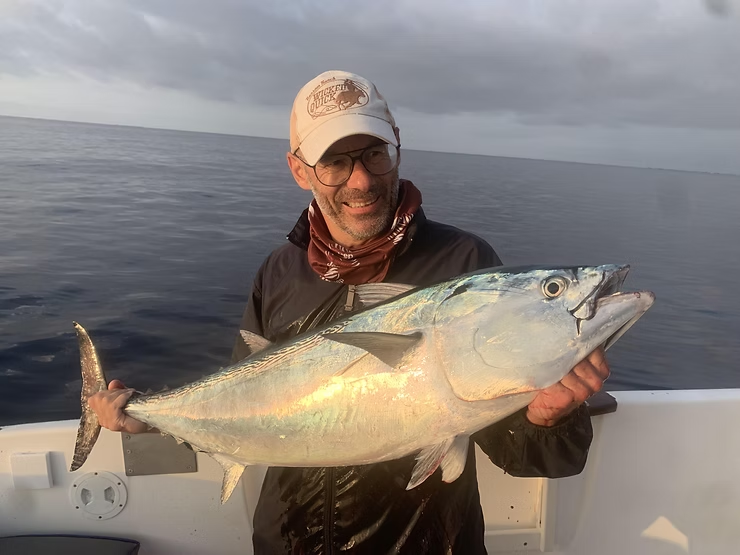
Even so, after 10 minutes of an intense fight, the bonito finally reached the boat — a 15-kilo fish, really a huge specimen for this species!
“This is exactly the kind of fish we came for, and the trip was already a success after just 30 minutes of fishing.”
The rest of the fishing session stayed just as productive for about three hours. We kept hooking fish on every drift, and every 20–30 minutes we brought another one to the boat — always big 10-kilo bonitos. Between 6:30 a.m. and 10:30 a.m., we landed 7 fish.
Out of respect for the fish, and since we had already brought two onboard, we decided to unhook the next ones directly in the water to avoid unnecessary bleeding and to help them swim off as quickly as possible.

After 10:30 a.m., with the big heat setting in, the fish started feeding less, and we were running out of sardines anyway so we decided to try catching bonitos on surface feeds.
The guide took us back toward the river mouth, but the bonito feeds were way too scattered. Even going full throttle and getting there first, the fish were already diving again, making this type of fishing basically impossible.
So we spent about an hour chasing small groups of bonitos, but they weren’t big enough yet to create real, steady surface feeds.

To wrap things up, sport fishing for bonitos in Spain on the Ebro Delta is truly an exceptional and well-preserved area, home to an impressive number of fish.
June is a good month for bonito fishing, but according to the guide, July, August, and September are the best, especially for surface-feed fishing, which is without a doubt the most exciting and spectacular technique.


Comments